


Chinnor – Burial Mounds
The two mounds you see in front of you were constructed in the Bronze Age, probably sometime between 2300 and 1800 BC – around 4000 years ago. They are two of several along the Ridgeway here in the Chilterns, but they are probably some of the best preserved and most accessible.
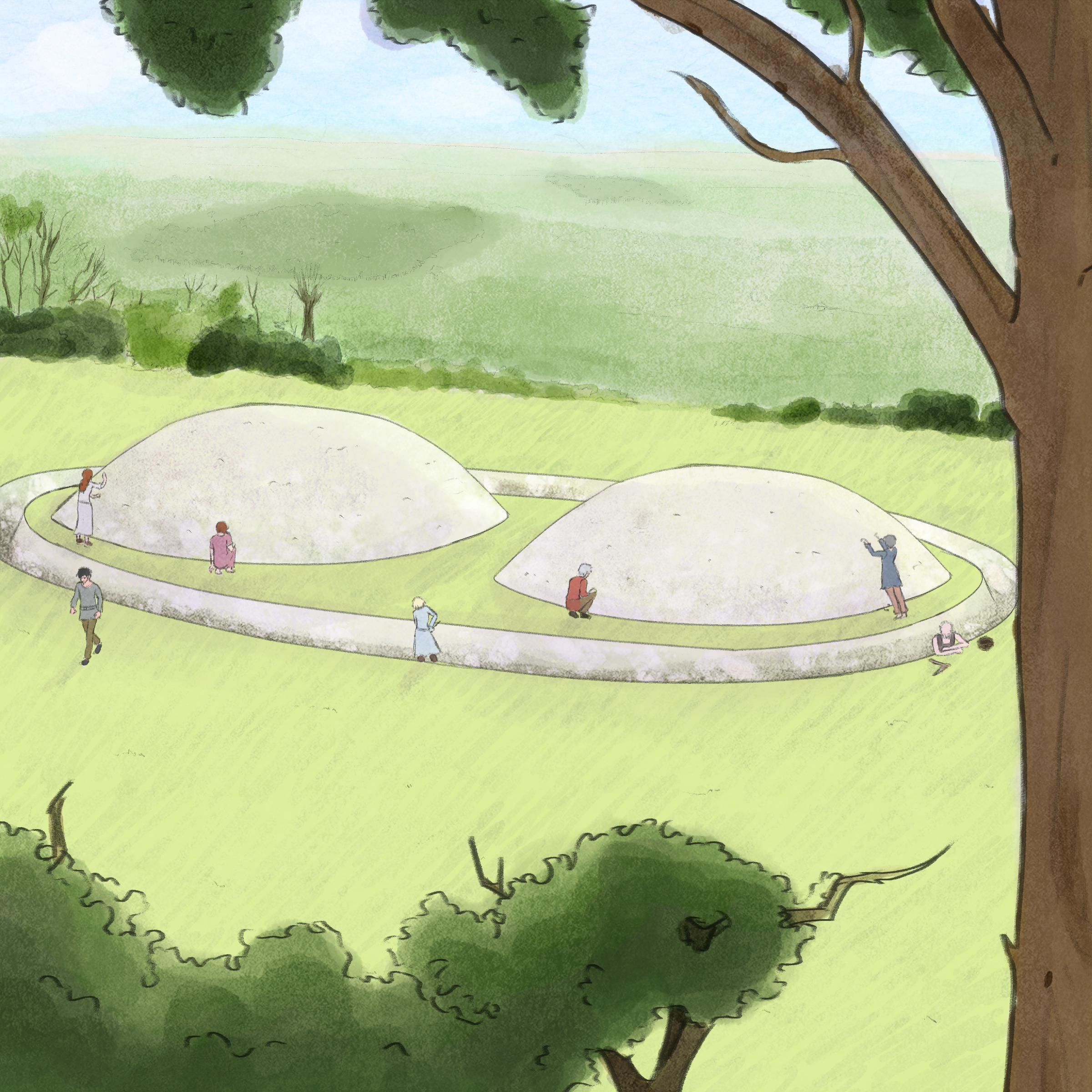
Barrows, or burial mounds, were built over individual graves of deceased members of the community, and they often were buried in particular ways, lying on one side, heads facing in a specific direction, and frequently with what we call ‘grave goods’, which is to say, objects that meant something either to the deceased person, or to their mourners, or which might have been seen as provisions for a journey to the afterlife. Most frequently in these Bronze Age barrows, we see ceramic jars, perhaps filled with beer. These jars were called ‘beakers’ by early archaeologists who excavated them, leading to these communities being known as the Beaker people.
The central grave would be dug and the person laid in it with their grave goods. Then a large circular ditch was then dug around the grave, and the material from the ditch heaped up over the grave, creating a large mound (the barrow) and a ring ditch. Here, on the chalk geology, the mound would have been bright white and in the sunshine, would have reflected the light. You can imagine up on this scarp edge height, and gleaming in the sun, the barrows would have been visible for great distances.
These twin barrows are slightly unusual as they have one ring surrounding both mounds, instead of each its own ditch. We can’t prove it, but it suggests that the individuals may have been buried at the same time, yet each important enough in their own right to merit their own mound. Much later – about 2500 years later – these barrows were reused by the local people in the Saxon period. This was a common thing to do all across England and parts of northern Europe. When workmen in 1899 dug into the mounds, they found an Anglo-Saxon body as well as spearheads and part of a sword scabbard.
If you’d like to learn more about these barrows you can visit the Historic England webpage for this Scheduled Monument. Scheduled Monuments are protected by law and it is a prosecutable offence to metal detect on them, or to damage them in any way. This includes cycling over them and having campfires or BBQ fires – even portable ones – on them. Help keep heritage protected for everyone!
Heritage Trails
This is one of four ‘Routes to the Past’ circular walks, made possible by The National Lottery Heritage Fund. You can find the other trails on the main Chilterns Interactive Map, under routes.
Each trail has four waymarkers with unique stories to tell – Find the other Chinnor Hill trail markers and scan their stories at the locations shown below.
