


Why deer management matters
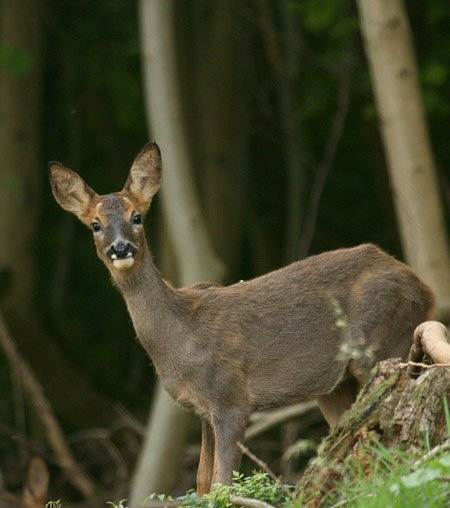
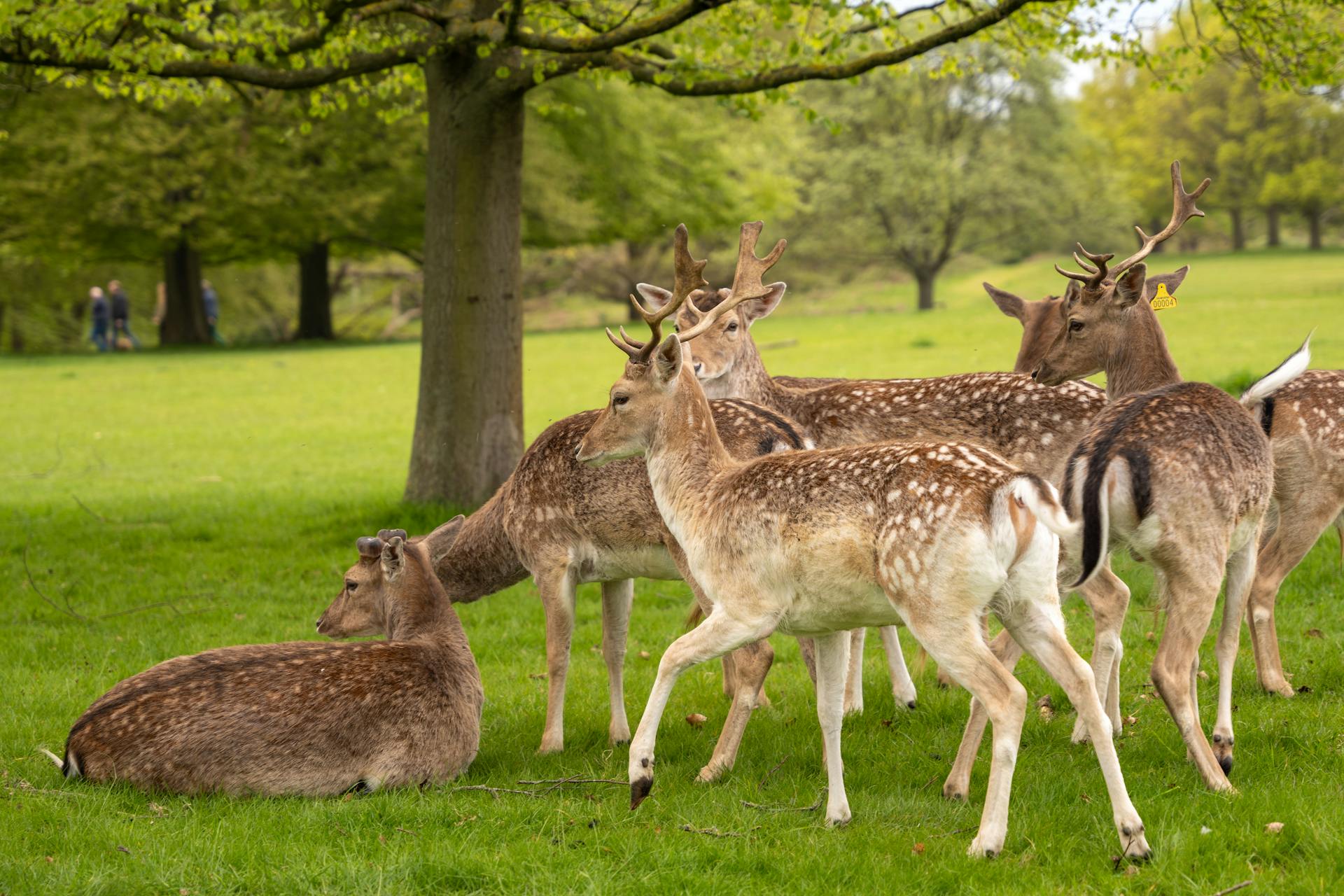
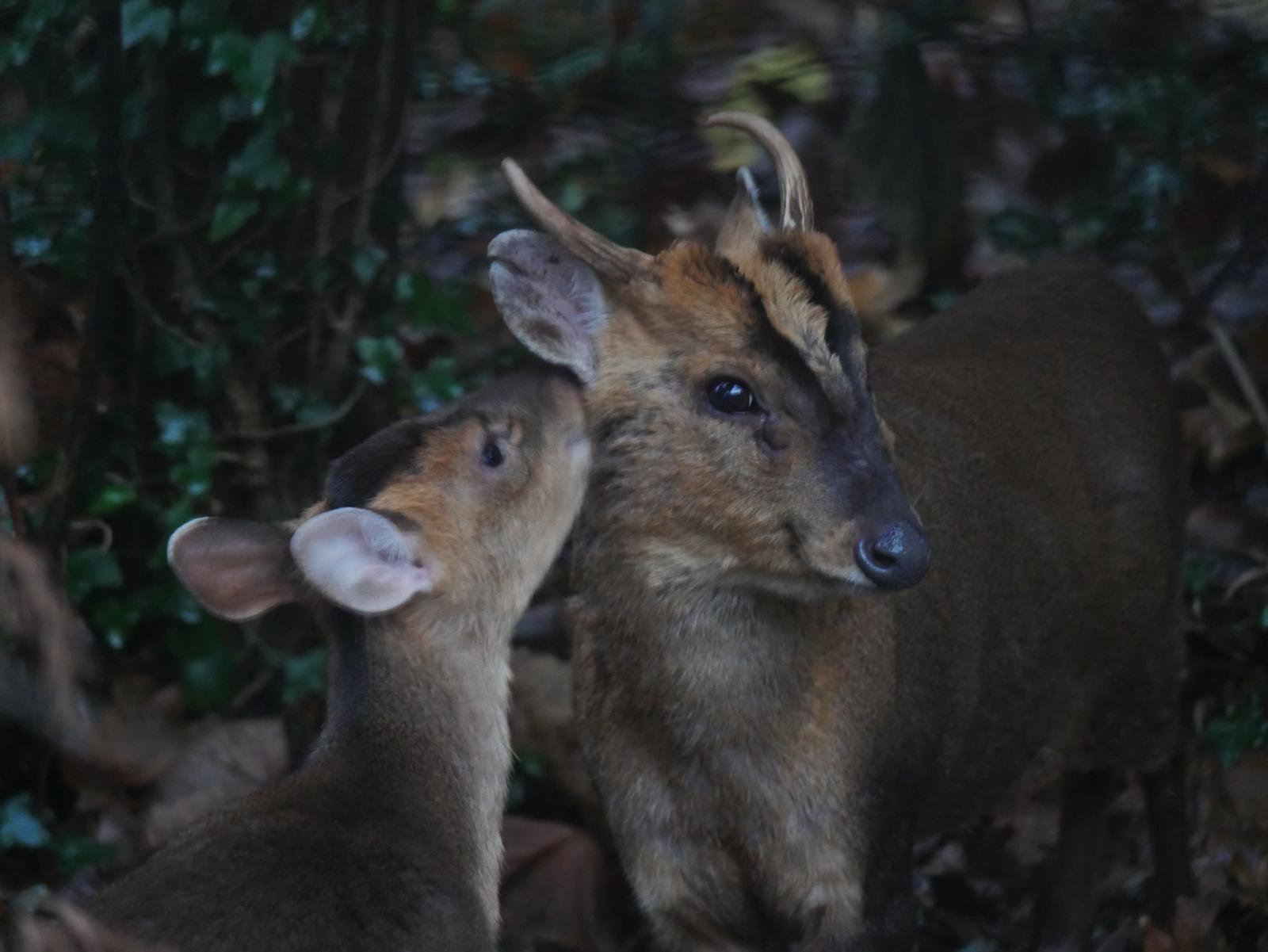
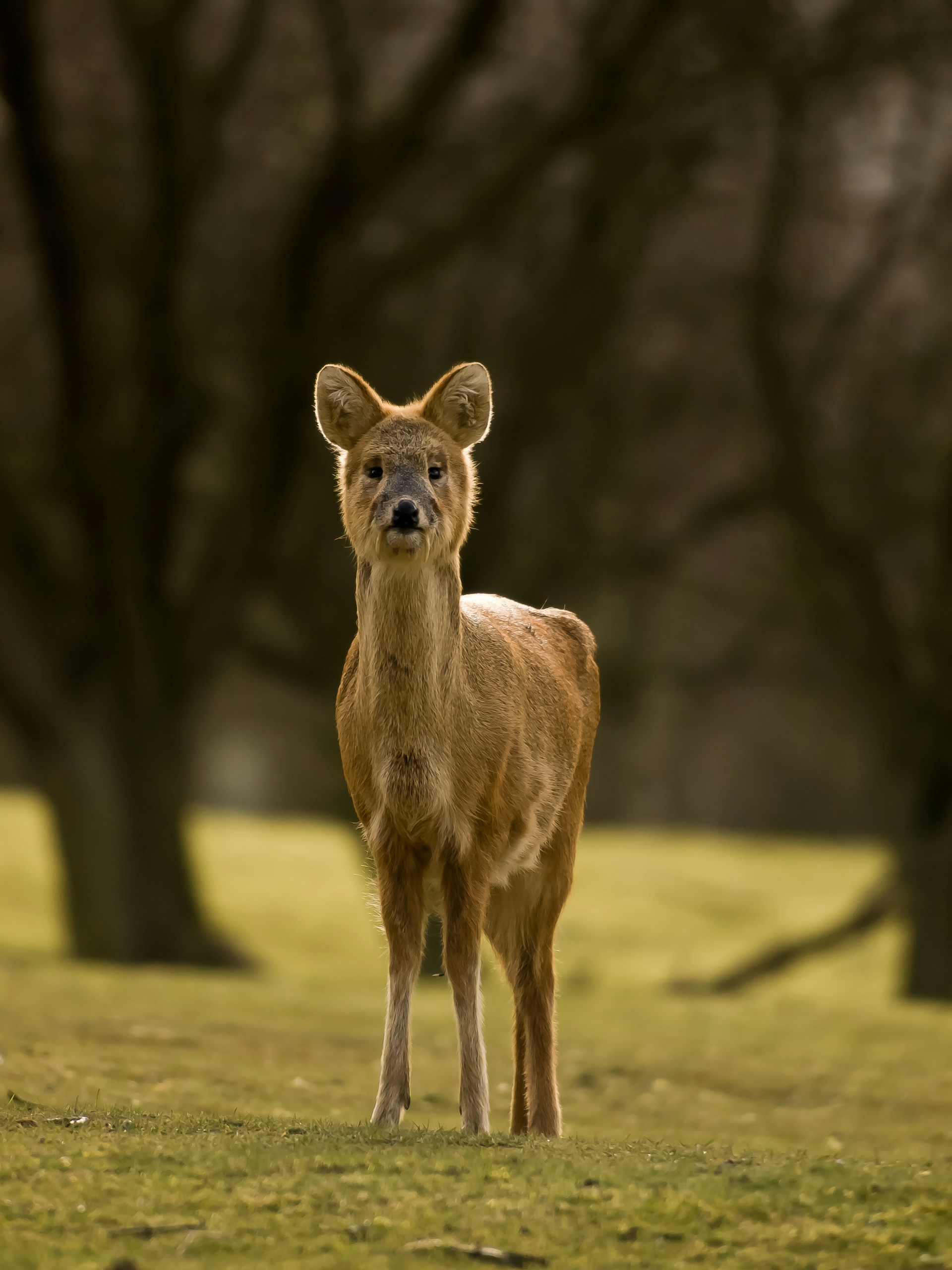
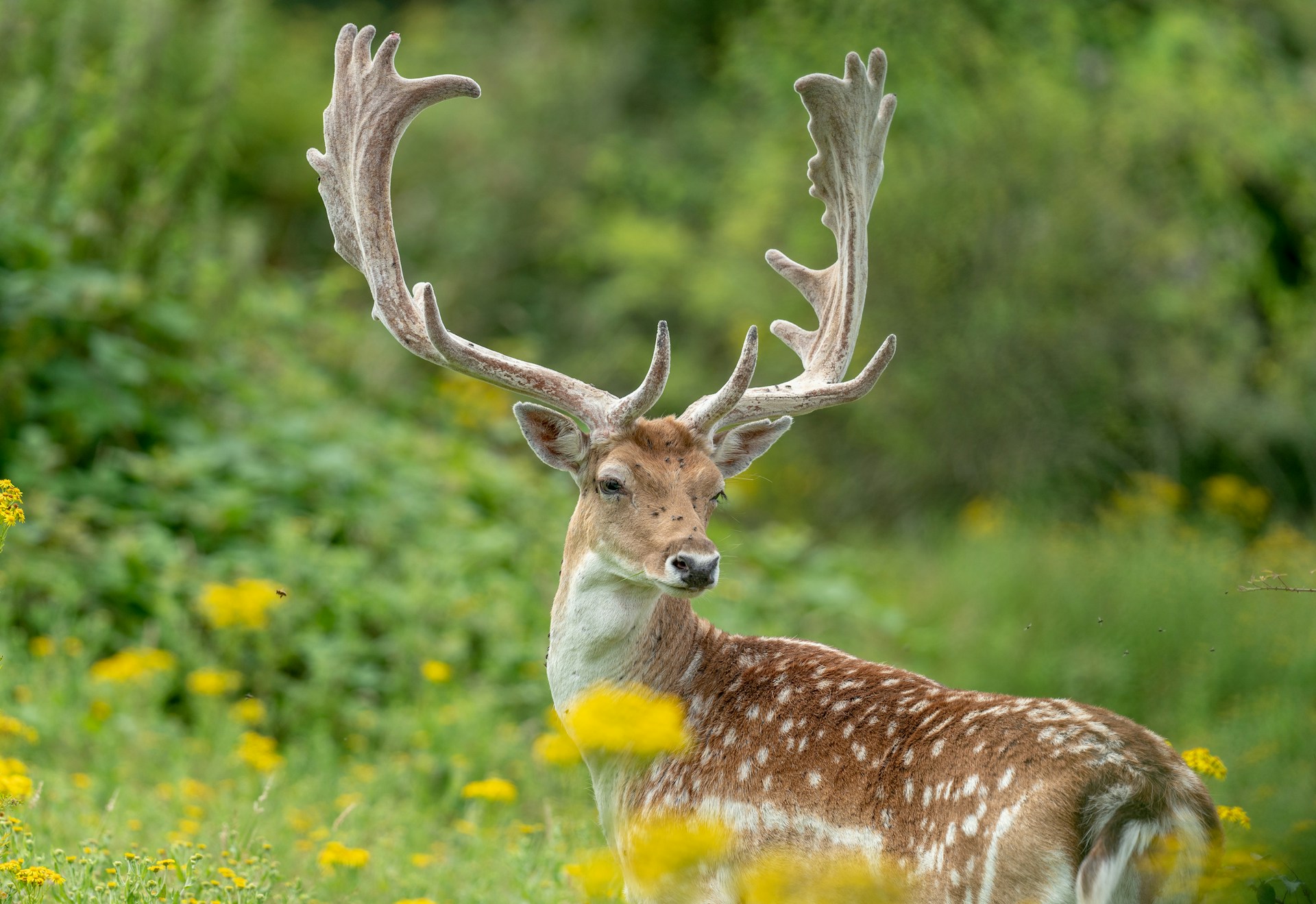
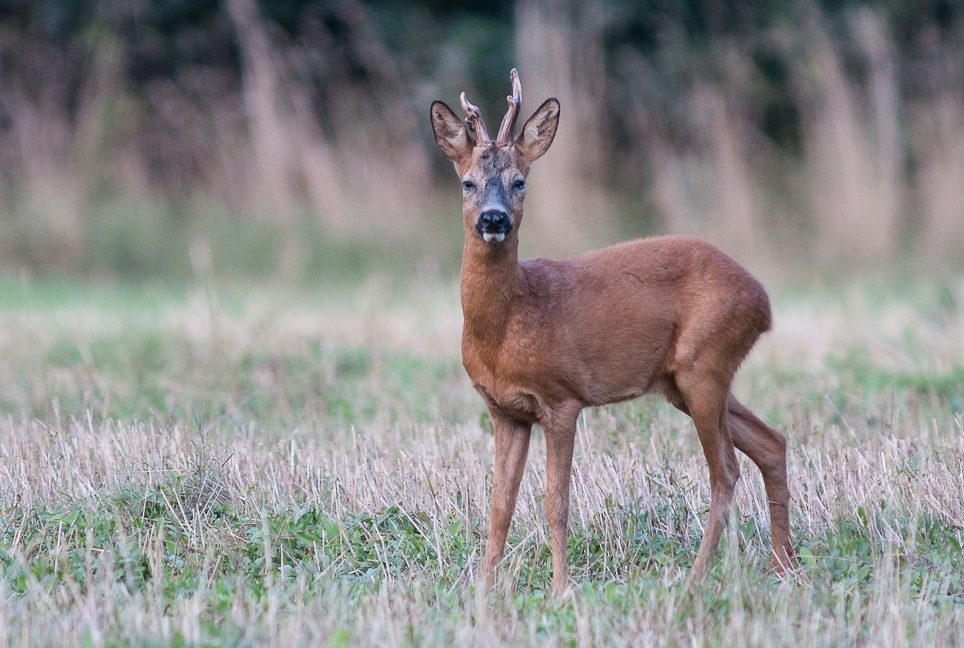
Deer are a familiar part of the Chilterns landscape. If you’ve ever spent any time walking in the woodlands, grasslands, or along hedgerows, then you’ve probably glimpsed a muntjac darting across a path or a roe deer grazing quietly in a sheltered valley. This mosaic of habitats provides ideal conditions for deer to thrive.
But caring for the Chilterns means more than enjoying these encounters. It also means understanding how deer populations are gradually changing the landscape we love. If you walk through a Chilterns woodland, it can feel timeless – tall trunks, dappled light, and a sense of calm. But look more closely, and you may notice something is missing. Young trees, wildflowers, shrubs and hedgerows are disappearing, slowly altering the character and future of the landscape.
These changes aren’t caused by development or disease, but by growing deer populations.
Grazing and browsing prevent new growth from establishing, and a single adult fallow deer can eat up to 6kg of vegetation a day. When numbers are high, the pressure on the landscape becomes severe and widespread across woodlands, hedgerows and farmland as the deer look for additional food.
These impacts show up in several key ways:
- Woodlands come under increasing pressure: browsing heavily on the understorey (plants beneath the tree canopy) prevents young trees, shrubs and bramble from growing and reproducing, and reduces ground flora such as the Chilterns’ iconic bluebells, which are favoured by the non-native muntjac deer.
- Biodiversity is lost: loss of flowers and understorey reduces nesting and feeding opportunities for insects, birds and mammals, including species such as the native Hazel dormouse.
- Hedgerows and farmland: large herds of fallow deer can cause significant problems by stripping hedgerows and eating and trampling crops, especially those near woodland edges. Lower agricultural yields will reduce farm incomes.
- Road safety: national statistics from the AA show deer collisions have increased by 34% since 2021, causing more than 400 injuries to car occupants each year.
- Deer welfare and risk management: high deer densities can lead to hunger, stress, and disease. For example, deer can carry ticks, which may transmit Lyme disease to humans. Trained deer managers and processors help monitor deer health, detect signs of illness, and handle carcasses safely.
 |
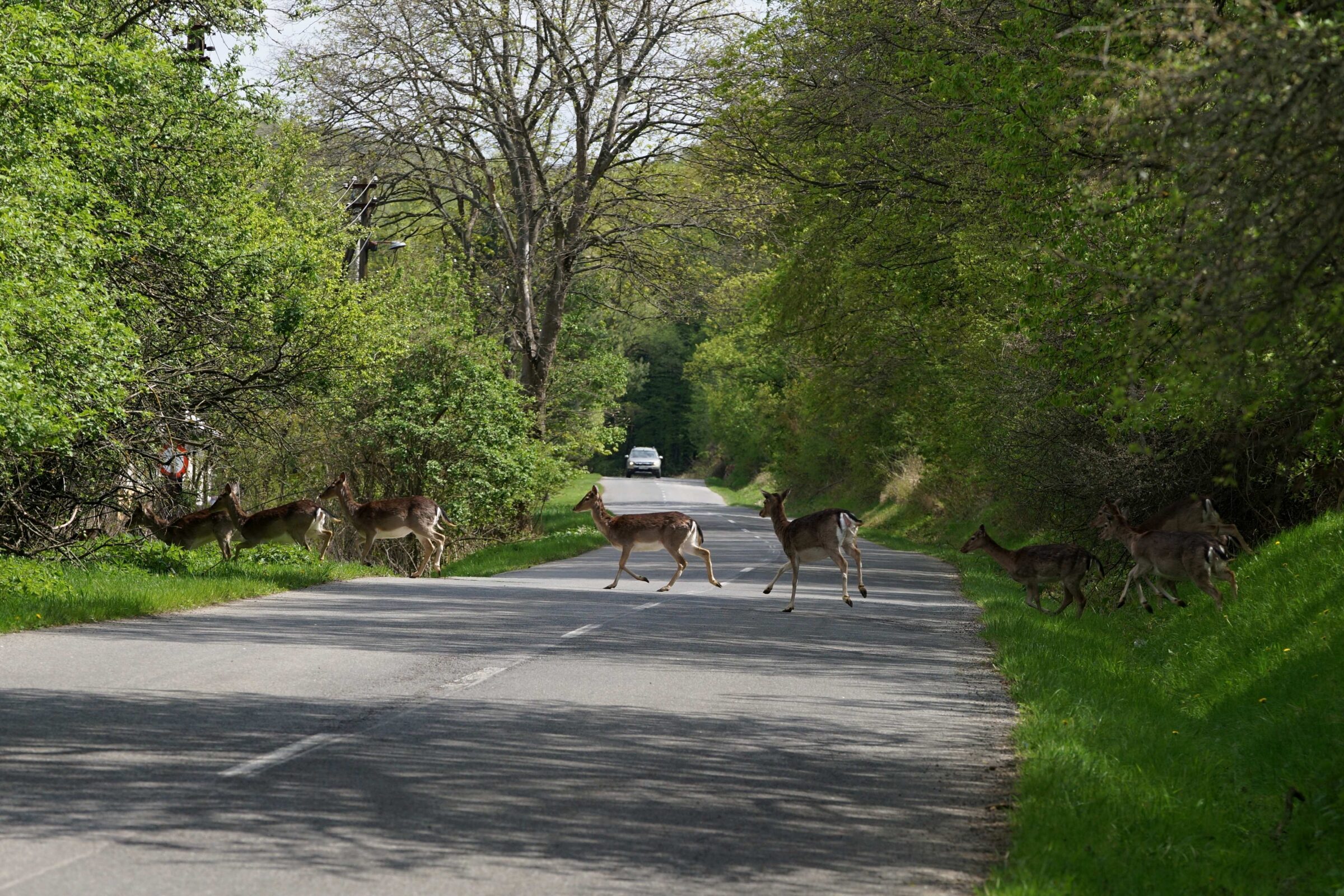 |
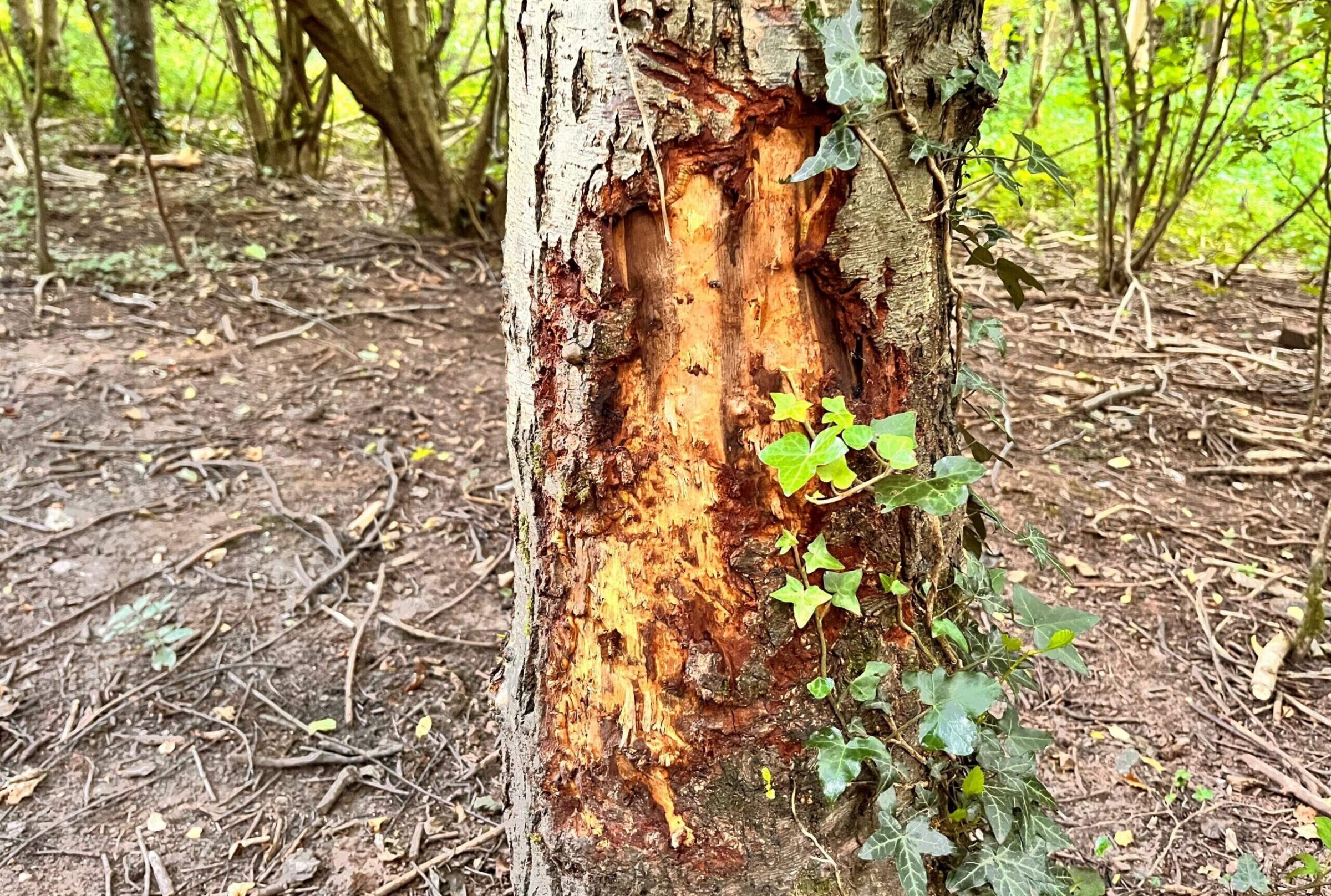
The images above show a). tree bark damaged by deer, and b). a fallow deer herd crossing a road (increasing risks to road users).
The images below show a piece of unbrowsed woodland in Southeast England. The first photo was taken just after removal of a deer fence. The second image shows the same woodland 18 months later after heavy deer browsing. The third image is of the same woodland six years later, after continued heavy deer browsing.
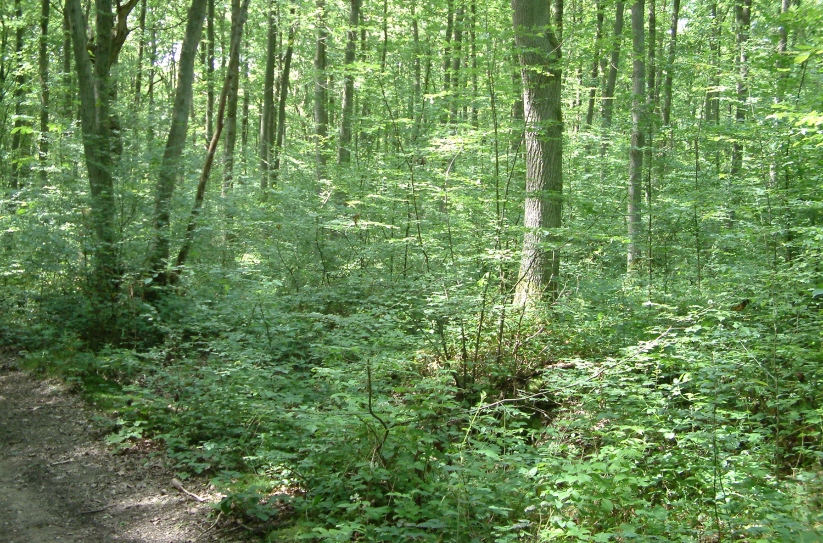
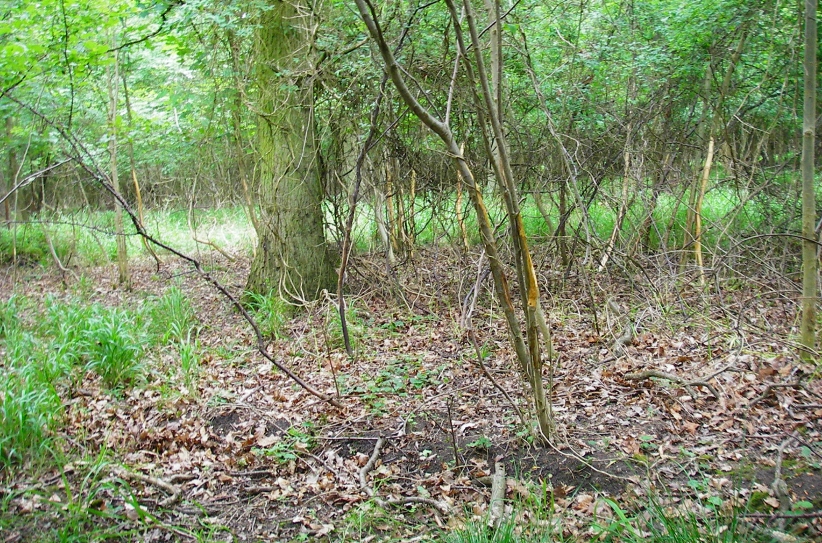
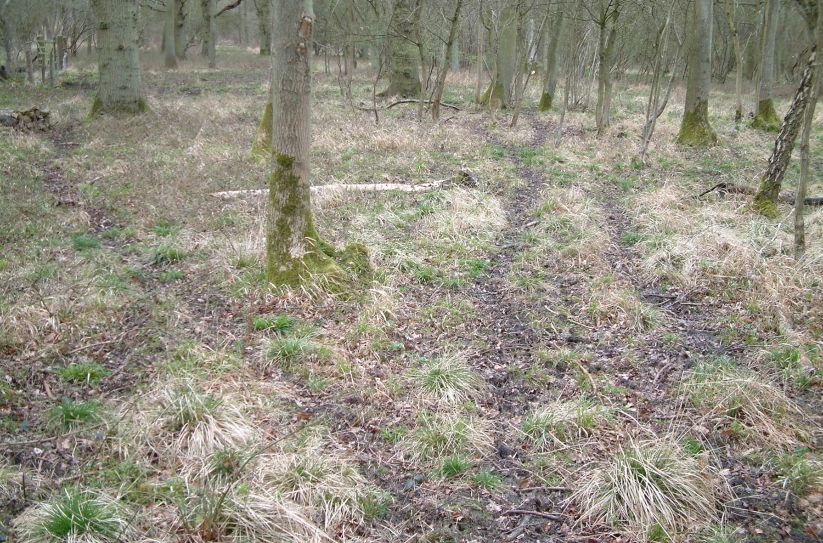
Credit: The Deer Initiative
Why deer numbers are rising
Of the six deer species found in the U.K., only red and roe are native. The remaining four species – fallow, muntjac, sika and Chinese water deer – are non-native and have become widespread. Four of these six species are now found in the Chilterns: roe, fallow, muntjac and Chinese water deer.
Several factors have or are contributing to increasing populations in the Chilterns:
- The absence of natural predators: large predators such as lynx and wolves no longer play a role in regulating deer populations, allowing numbers – particularly of non-native species – to thrive.
- Milder winters: warmer conditions linked to climate change increase survival rates for fawns and reduce natural winter mortality.
- Population dynamics: sex ratios are skewed towards females, accelerating population growth (thermal drone survey, Chilterns National Landscape, February 2025).
- Fragmented land ownership: land is divided between many different owners, making coordinated deer management more complex and requiring collaboration across boundaries.
- A reduction in deer management during the Covid-19 pandemic.
Together, these factors mean that deer populations in the Chilterns are now higher than the landscape can sustainably support, increasing pressure on woodlands, farmland and wildlife habitats.
What the evidence tells us
Surveys provide a clear picture of deer populations (including densities and distributions) – and their impacts in the Chilterns.
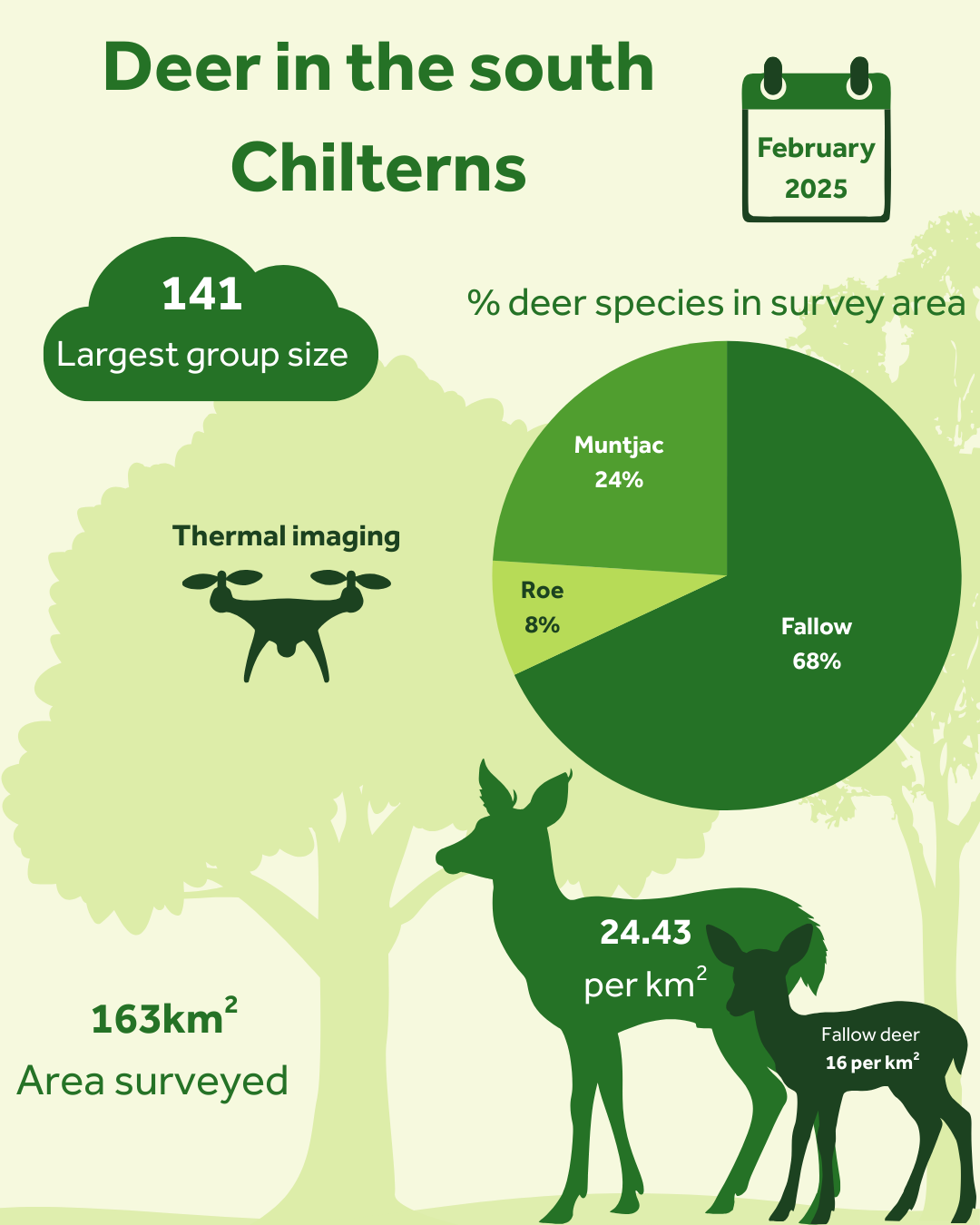
Many landholdings keep records of deer numbers, which show noticeable increases in recent years. In addition, drone technology now allows populations to be surveyed more accurately over large areas. In February 2025, a thermal drone survey across the southern Chilterns found high densities of fallow deer in this area.
- Area surveyed: 16,500 hectares (~165 km²).
- Deer counted: 4,901 individuals (roe, fallow, muntjac).
- Overall density: 24.43 deer per km².
- Fallow deer density: 16 per km².
- Population structure: strongly female-biased; 77% of identifiable fallow deer were does, indicating potential for continued rapid population growth.
Although deer density alone is not a reliable predictor of impact (Spake et al., 2020; Putnam et al., 2011), when combined with Deer Impact Assessments we can assess whether woodland regeneration is being negatively impacted, putting young trees, understorey plants and ground flora at risk. The level at which damaging impacts to natural regeneration is likely to occur is 4-5 fallow deer per km2 (according to Research Report 09/2 by the Deer Initiative).
Other thermal drone surveys have confirmed both the widespread distribution of roe and muntjac across the Chilterns, displacement of roe deer in areas with large fallow herds, and concentrated fallow populations, for example at the National Trust’s Ashridge Estate in Hertfordshire, a Special Area of Conservation (SAC).
When thermal drone survey data is combined with Deer Impact Assessments for particular landholdings, independent observations across a range of habitats in the Chilterns and reduced agricultural yields, we know that there is a problem.
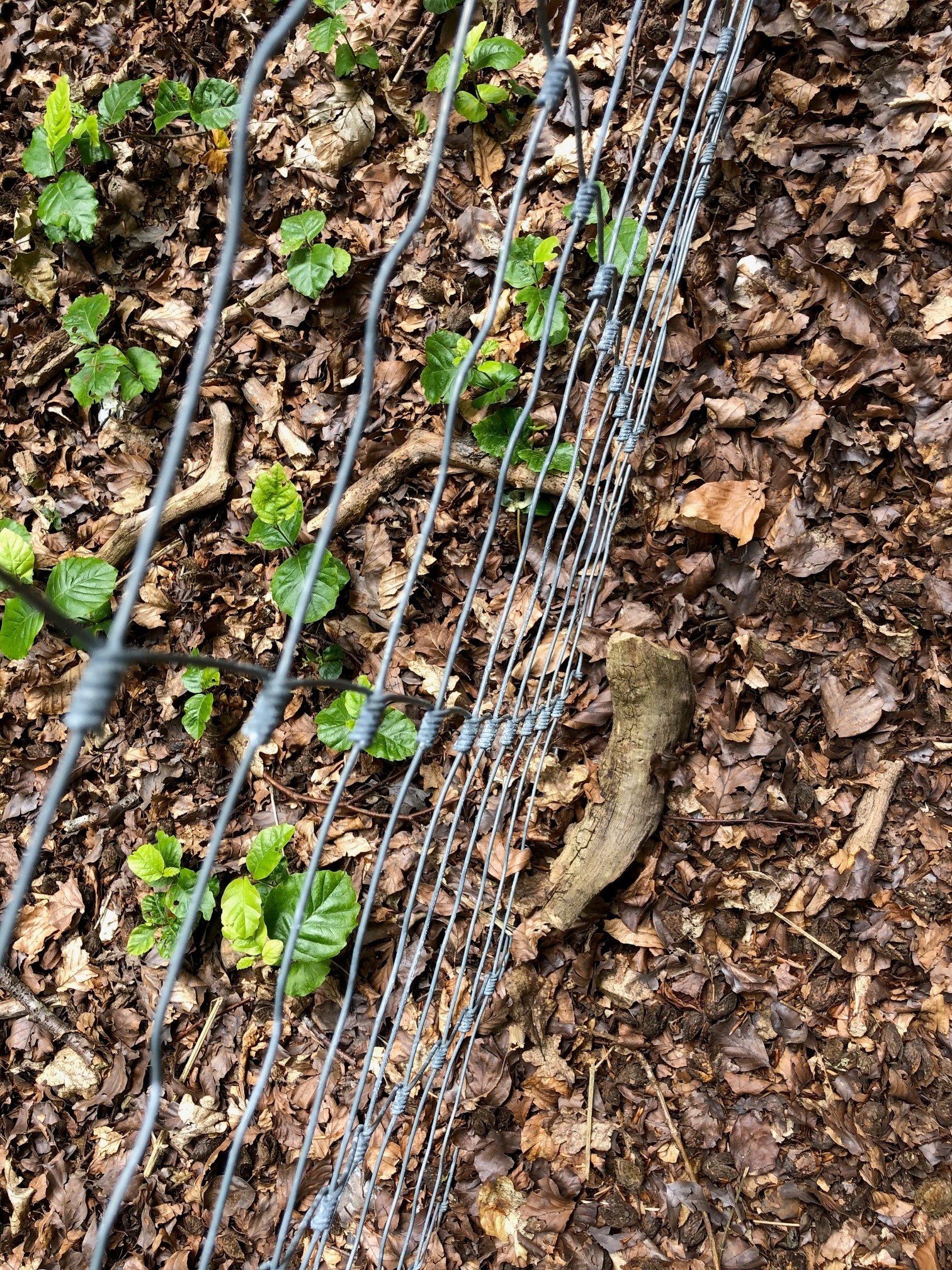
The photo to the right shows a section of woodland floor within weeks of installing deer impact enclosure fencing. In the absence of deer, the ground on the left is showing signs of regeneration of young beech tree shoots. In the presence of deer, the ground on the right of the fence line is bare.
What deer management really means
Deer management is the planned and lawful control of deer numbers, usually through culling (lethal control) to keep populations at a level the landscape can support. Importantly, this is carried out to a plan that takes into account ecosystems, land use and sustainability.
It is one of the most sensitive and often misunderstood aspects of countryside conservation. Deer are valued and admired animals, and culling deer can feel uncomfortable to talk about. But where natural predators are absent and landscapes are heavily shaped by people, managing deer numbers is essential to prevent long-term ecological damage and animal suffering.
In the Chilterns, the National Landscape team advocates taking an evidence-led approach, using tools such as thermal drone surveys and habitat monitoring to understand how many deer there are, where they are concentrated, and where pressure on habitats is greatest. This ensures decisions by land managers are based on real impacts, not assumptions.
Collaboration is essential. Deer move freely across boundaries, so effective management depends on cooperation between:
- Farmers and landowners
- Trained professional deer managers
- Local communities and partners
Ethical standards and training are central to all deer management activity. Professionals follow strict welfare guidelines and receive extensive training to ensure humane, ecologically responsible interventions.
Why action is needed now
Deer management in the Chilterns has reached a critical point. Recent changes in climate, land use and population dynamics mean that existing pressures on the landscape are intensifying, while the window for effective, coordinated action is narrowing.
Several recent factors have increased pressure on the landscape:
- Climate change: milder winters are improving fawn survival, allowing populations to grow more quickly.
- Covid-19: temporary reductions in culling during the pandemic allowed deer numbers to rise further.
At the same time, this is also a moment of opportunity. We now have better tools, stronger partnerships and clearer direction than ever before:
- Better evidence: improved monitoring, including thermal drone surveys, gives a clearer picture of numbers and impacts.
- Stronger coordination: the Chilterns Nature Recovery Plan and supporting Local Nature Recovery Strategies (LNRS) have been published helping to guide habitat protection and biodiversity recovery at a landscape scale.
- Better collaboration: the creation of farmer clusters across the Chilterns has enabled landowners to collaborate to carry out strategic joined up approaches to managing deer on their land.
- Growing public awareness: more people are thinking carefully about where food comes from. Responsibly sourced wild venison offers a way to support the landscape while choosing a healthy, local, low-impact food.
- On 20 February, 2026, a government policy paper was published which sets out the actions Defra will take over the next 10 years: Deer impacts policy statement: managing the impacts of wild deer in England.
Together these factors make action both urgent and achievable. Acting now gives us the best chance to protect the Chilterns’ woodlands, wildlife and landscapes for the future.
“We live in one of the most nature-depleted nations on earth, composed of modified landscapes which need progressive management to restore and recover our treasured wildlife. The good news is we know how to do it and we can do it.
But to ensure we establish the richest mosaic of habitats, we unfortunately have to make some hard choices and managing a burgeoning population of deer is one of them. And let’s be clear, this is not sports shooting or hunting, this is about culling, management.
If we want to reforest, if we want sustainable populations of woodland birds and butterflies, we currently have no other options. A joined up national policy implemented and supported by science will make a difference for biodiversity.”
Chris Packham on deer management (February 2026) Read full article.
What’s happening in the Chilterns
Deer management in the Chilterns is not about removing deer completely. It’s about keeping populations at a level the landscape can support, ensuring woodlands, farmland, wildlife – and deer themselves – can thrive.
The Chilterns National Landscape works with landowners, trained deer managers, and local communities to:
- Survey and monitor deer to understand where they are, how many there are, and identify the pressure they place on habitats.
- Assess impacts on woodlands, hedgerows, and farmland.
- Support humane management including culling where necessary, in line with high animal welfare standards.
- Increase and build local processing capacity to help landowners manage carcass processing safely and efficiently through funding such as the Farming in Protected Landscapes programme.
- Promote wild venison as part of a sustainable food system that supports the local economy and landscape.
How people can help
We can all have a role to play in caring for the Chilterns, from learning how deer affect our landscapes, to supporting responsible management and making thoughtful decisions in what we eat.
Even small actions, like buying local wild venison to cook at home, or ordering it in a local pub or restaurant, directly support a healthy Chilterns landscape.
FAQs
What is deer management?
Deer management is the control of deer numbers, usually by culling (lethal control). This is carried out according to a plan that considers ecosystems, land use, and sustainability. Population and impact monitoring are essential parts of the process. Deer management requires landowner permission, adherence to welfare best practice, seasonal restrictions, and a valid firearms certificate.
What are deer managers (also known as "deer stalkers”)?
Deer managers are the trained professionals assessing the deer populations and ensuring humane management of deer.
Is deer management just about killing deer?
No. Deer management is about preventing long-term harm. Without intervention, deer populations can grow beyond what the land can support, leading to suffering, starvation, and habitat loss. Careful management is about balance and responsibility.
Why can’t nature regulate itself?
Historically, large predators kept deer populations in check. In today’s landscape, humans have removed those predators and reshaped habitats, which means we also carry responsibility for managing the consequences when populations grow unsustainably as a result.
Are deer treated humanely?
Yes. Management is carried out by trained professionals following strict welfare standards. Ethical practice and respect for animals are central to good management.
How are deer numbers monitored?
Deer numbers can be monitored directly via counts, for example by thermal drone surveys.
How is the impact of deer on the landscape established?
Deer impact can be estimated using impact assessments and visual signs. One method is to install a deer exclosure plot (a 4×4 m² fenced off area) which can compare vegetation growth inside and outside the plot to assess browsing pressure.
Are there alternatives to deer management (culling)?
Introducing natural predators would have a negligible effect on populations. Alternative strategies such as contraception are not feasible for wild deer, due to challenges in efficient delivery. For a detailed review of fertility control options, see the British Deer Society’s Deer Fertility Control Review (2018).
What is “Closed and Open Season”?
Deer can only be legally culled during the open season, which varies by species (BDS Open Season Guide). Closed seasons protect breeding and fawning deer. Compliance ensures welfare and conservation standards are met.
Why does it matter who landowners choose to manage their deer populations?
Deer move freely across land boundaries, so uncoordinated management can be ineffective. Choosing trained professionals ensures culling is humane, evidence-led, considers habitats and neighbouring land, and maintains legal compliance.
What legal protections are there for deer?
Deer are protected under the Wild Mammals (Protection) Act 1996, which prevents cruelty or unnecessary suffering.
Open and closed seasons protect deer with dependent young (BDS Open Season Guide).
Culling requires appropriate permissions and follows ethical and welfare guidelines.
What is the Wild Mammals Act?
The Wild Mammals (Protection) Act 1996 makes it an offence to intentionally cause unnecessary suffering to wild mammals, including deer. Legal culling by trained professionals, following welfare guidance and seasonal restrictions, complies with this law.
Is wild venison safe to eat?
Absolutely. All deer carcasses are processed by trained professionals, with checks in place to ensure food safety and quality.
Are there health risks associated with deer?
High deer densities can contribute to the spread of ticks, which may carry Lyme disease. Trained managers and processors monitor deer health and handle carcasses safely, reducing any risk to people, livestock, or wildlife.
Why not just use deer fencing to solve the problem?
Deer fencing is sometimes used, but only as a last resort for smaller areas. This is because it would be prohibitively expensive and unreliable to fence every problem area, as well as causing animal welfare issues if deer become trapped.
Sources and additional reading
-
- BBC News: Why Britain has a deer problem – leaving damage that costs millions
- British Deer Society – Deer Management and Conservation
- British Deer Society – Deer open season
- British Ecological Society: Forest damage by deer depends on cross-scale interactions between climate, deer density and landscape structure
- The Deer Initiative
- Defra – Threshold Densities for Wild Deer in England – guidance on population densities and impacts
- Forestry England – Managing deer in the nation’s forests
- High Weald National Landscape Deer Management
- Wild Mammals (Protection) Act 1996
- Wiley online library: Identifying threshold densities for wild deer in the UK above which negative impacts may occur
- The Woodland Trust – Deer Management Position Statement